Why was this number flagged? The card tells you
Each verdict comes with a reason in plain words: how often the number was reported, how recently, and which source it came from. Here is every reason the app can give.
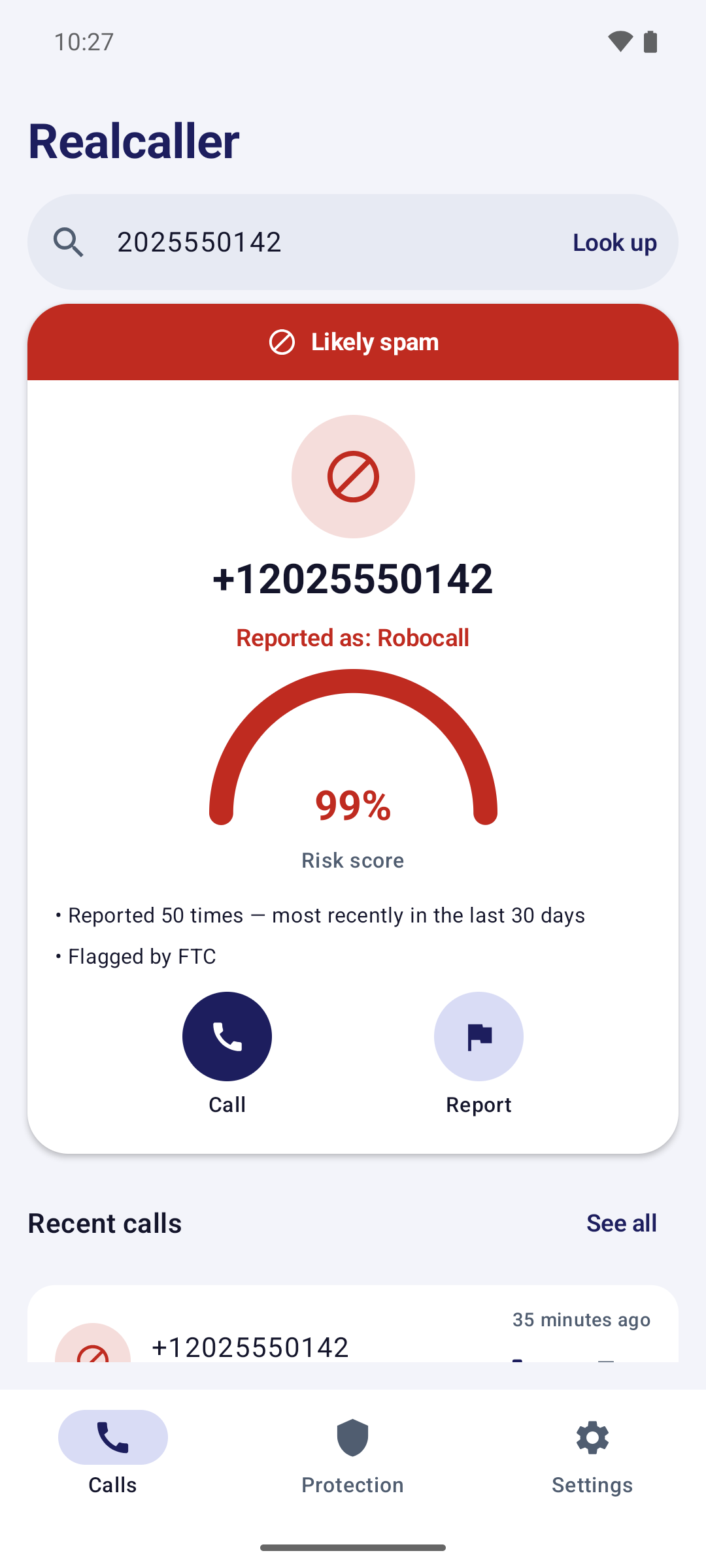
Where do I see the reason?
On the card, in the number search and in the call details.
A notification card shows the strongest reason as its first line, for example “Reported 50 times, most recently in the last 30 days”. The number search shows up to three reasons, strongest first, next to the verdict and the risk percentage.
Reasons come from the data behind the number. They name counts and sources, never people. The app does not show who reported a number.
What reasons can a card give?
Thirteen lines in all. The ones about Realcaller users appear only once users have reported a number.
| What the card says | When it appears |
|---|---|
| Reported N times, most recently in the last 30 days | A data source (FTC or FCC) has complaints about the number, the latest within 30 days. “Reported once” when N is 1. |
| Reported N times, most recently over 30 days ago | Same, but the latest complaint is older than 30 days. |
| Flagged by FTC (or Flagged by FCC) | The source of the number. The name of the source is shown as it is. |
| Reported by N Realcaller users in the last 30 days | App users reported the number. N is the count of different phones. |
| Reported by N Realcaller users, M in the last 30 days | Same, when older reporters are counted too. |
| Reported by N Realcaller users, most recently over 30 days ago | Users reported it, but none in the last 30 days. |
| Recent activity spike, N reports in 24h | At least 5 reports from Realcaller users in 24 hours. |
| Reported by Realcaller users | The number is known only from user reports and no count line applies. |
| Source data is from US; your region is MX | A live lookup of a number whose source data is from another country than your SIM’s. Never shown for offline-list answers. |
| This number is from MX; your region is US | Same idea, for a number known from user reports from another country. |
| New number, no reports yet | Nothing is known about the number and no one has reported it. |
| Couldn’t check this number in time | No answer arrived within the app’s time budget. The card is titled “Unknown caller, not checked”. |
| Internal reputation signal | Reserved for sources that may influence a score but whose name is not shown. None is in use today. |
Country names appear in the language of the app. The wording is the app’s own, adapted here to avoid dashes. As of no Realcaller user has reported a number, so the user lines are described here but not yet seen on real numbers.
What do “known spam”, “suspicious” and “low risk” mean?
They are bands on a score from 0 to 1. The score is the same one behind the risk percentage in the number search.
- Known spam: 0.70 or higher
- Strong evidence: many complaints, from a trusted source, recently. The title reads “Known spam call”, and the search says “Likely spam”.
- Suspicious: 0.40 up to 0.70
- Some complaints, not enough for the top band. The card asks you to proceed with caution.
- Low risk: below 0.40
- Few or no complaints, or a number nobody has reported. It means “not flagged”, not “safe”.
How is the score worked out?
Four ingredients, each with a fixed weight. The formula is locked: it cannot change without a deliberate review.
- How many reports (50%)
- The more complaints, the higher the score, up to a cap at 50. Each FTC or FCC complaint counts as 1, and counts fade a little each night.
- How much the source is trusted (20%)
- FTC data weighs 1.0 and FCC data 0.9. A number known only from user reports starts at 0.4.
- How recent it is (20%)
- The freshness drops to about a third 30 days after the last report, keeps fading after that, and never goes below a small floor.
- Region match (10%)
- Full credit when the number’s source country matches your SIM’s country, and 30% credit otherwise.
The offline list leaves out the region part, so a number can score slightly differently there. Offline protection. The long version, with examples, is in Our data.
Where does the data come from?
Today, from two United States government complaint sources. Nothing else is loaded.
| Region or source | What the app has today | Notes |
|---|---|---|
| United States, FTC | Do Not Call complaints, a rolling window of about 30 days of daily files. | Public domain. Weight 1.0. Also the source of caller labels such as Debt relief, Impostor and Robocall. |
| United States, FCC | Consumer complaints in the “Unwanted Calls” category. | Public domain. Weight 0.9. |
| Mexico | No seed data. | Mexico has no public, downloadable list of reported phone numbers that the app can use today: the regulator’s successor publishes none, PROFECO’s data has no phone numbers, and CONDUSEF offers a manual web lookup but no dataset. Mexican coverage can come only from user reports. |
| United Kingdom, India | No seed data. | No importable number list exists. User reports only. |
| Anywhere else | No seed data. | Any valid number can be looked up. With no data and no reports it reads “New number, no reports yet”. |
As of : 813,371 US numbers, no user reports. FTC and FCC data are pulled again every Monday, and scores are recomputed every night.
Can a number be flagged wrongly?
Yes. Complaints can be mistaken, numbers get reassigned, and a spoofed number can belong to an innocent person.
That is why the card gives its reason instead of just a colour: you can judge whether “Flagged by FTC” with a few old complaints is worth worrying about. Numbers you mark “Not spam” go on your allowed list and are never blocked.
Counts, not accusations: a flagged number is one that people complained about, which is not proof about a particular call.
Questions about reasons and scores
What does “Flagged by FTC” mean?
Does the app say who reported a number?
Why is a number “Low risk” if it is a scam?
Do reasons work for Mexican numbers?
Is the score the same on a live lookup and the offline list?
Keep reading

Join the waitlist
Realcaller is in development and not on Google Play yet. Leave your email and country, and we will use them only for the waitlist.