Caller ID that tells you why.

When an unknown number calls, Realcaller checks it and posts a card with what it found and the reason behind it, like “Flagged by FTC”. Your contacts never leave your phone. No ads, no account.
  • Not on Google Play yet
  • Call screening on Android 10+
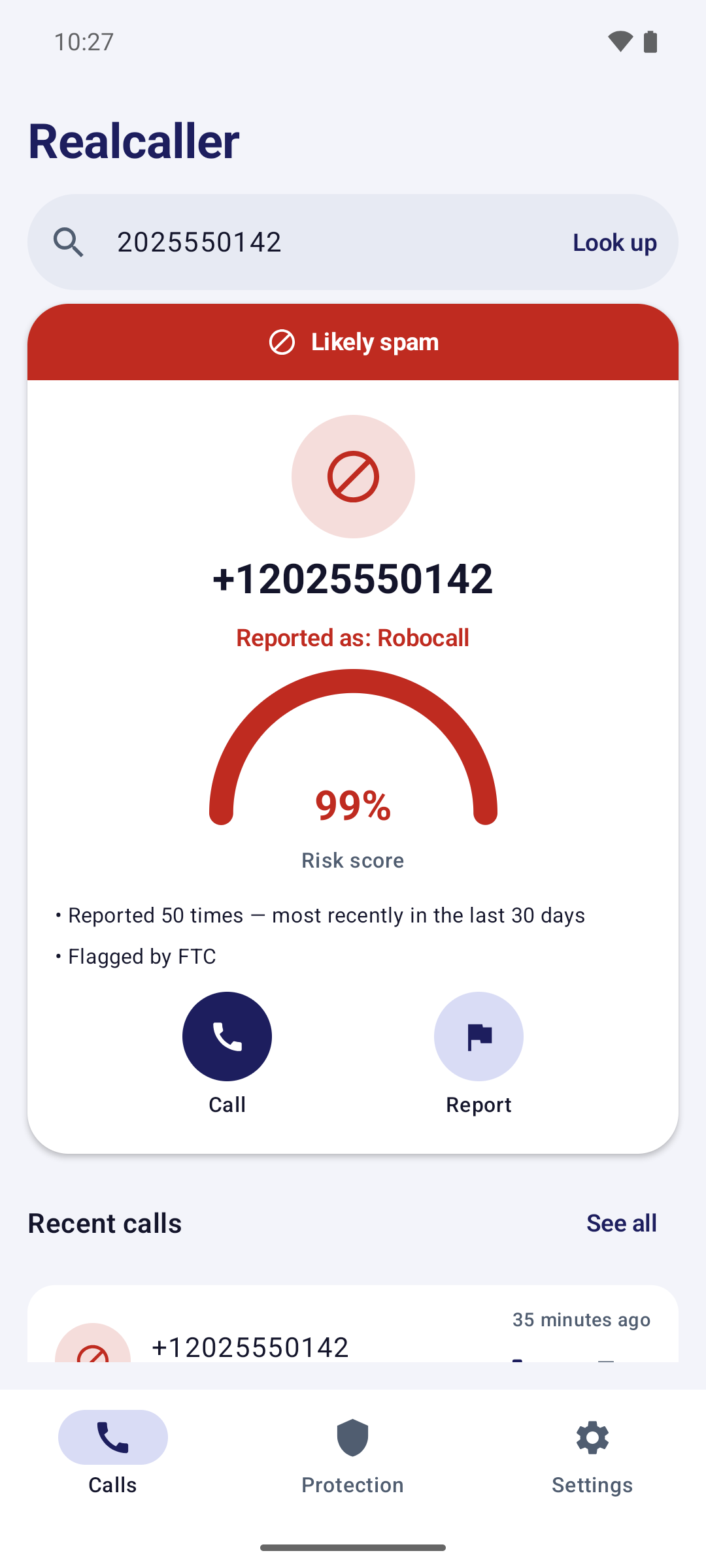
The Realcaller number search for a fictional number: “Likely spam”, a 99% risk score, “Reported as: Robocall”, and two reasons: reported 50 times in the last 30 days, and flagged by the FTC.
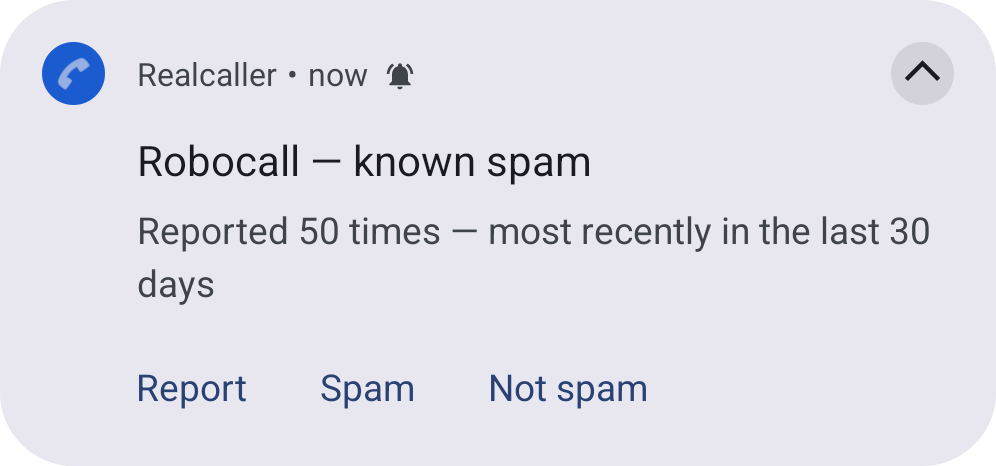
A Realcaller notification card: “Robocall, known spam”, reported 50 times in the last 30 days, with the buttons Report, Spam and Not spam.

What we promise

  • Contacts stay on your phone

    Read on the phone only if you allow it, so your contacts’ calls get through. Never uploaded.

  • No ads, no trackers

    The app has no advertising, analytics or crash-reporting code from other companies.

  • No account to create

    No sign-up and no login. Your phone makes its own random ID.

  • Reasons, not just labels

    Cards show why a number was flagged: how often it was reported, and by whom.

What happens when an unknown number calls?

Realcaller checks the number in a fixed order, starting with what is already on your phone. It only asks its server when the phone has no answer.

  1. Your own lists first

    If you allow contacts access, your contacts’ calls pass without a card. Then your blocklist and your allowed list. Nothing is sent.

  2. The list on your phone

    Next, the offline list your phone downloads every day: up to 10,000 numbers for your region.

  3. A quick lookup if needed

    With no answer on the phone, it asks the server over HTTPS, sending the number and your SIM’s country. Never a device ID.

  4. A card with the reason

    A notification card tells you what Realcaller found and why. If no answer came back in time, the card says the number was not checked.

Automatic checks need Android 10 or newer, with Realcaller chosen as your caller ID and spam app. The app installs on Android 9, and number search works on both.

How it works, step by step

Why was this number flagged?

The card tells you. Each reason comes from the data behind the number: how many complaints it has, how recent they are and where they came from.

How often, and how recently
Complaints about the number and when the last one arrived. Recent reports count for more than old ones.
Who flagged it
Where the data comes from, like the FTC or the FCC in the United States. The text of a complaint is never shown.
What kind of call
A short label such as Robocall or Debt relief, when the data has one.
When nothing is known
A new number with no reports shows as low risk, and the card says it has no reports yet.

Up to three reasons per number, strongest first. The card shows the first one; a number search shows all of them.

How a number gets flagged
Realcaller card: “Robocall, known spam”, reported 50 times, most recently in the last 30 days.
Known spam: the label and how often it was reported.
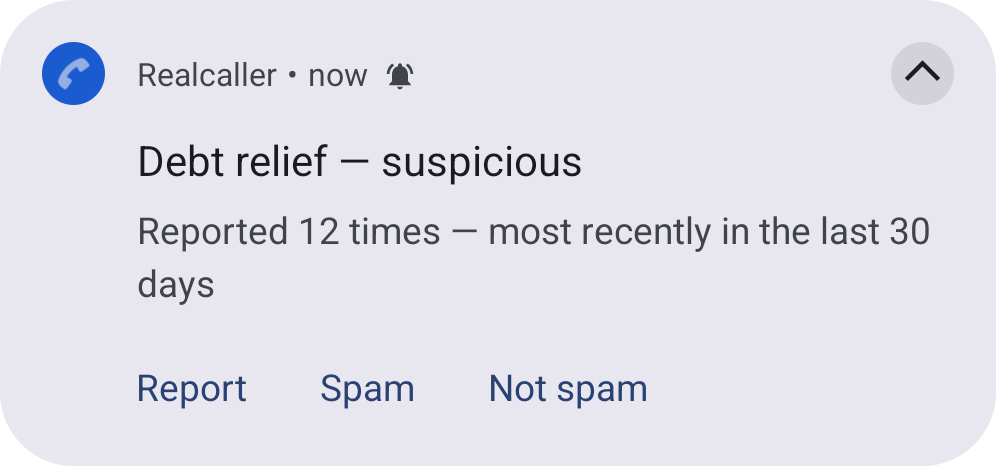
Realcaller card: “Debt relief, suspicious”, reported 12 times, most recently in the last 30 days.
Suspicious: some reports, so take care.
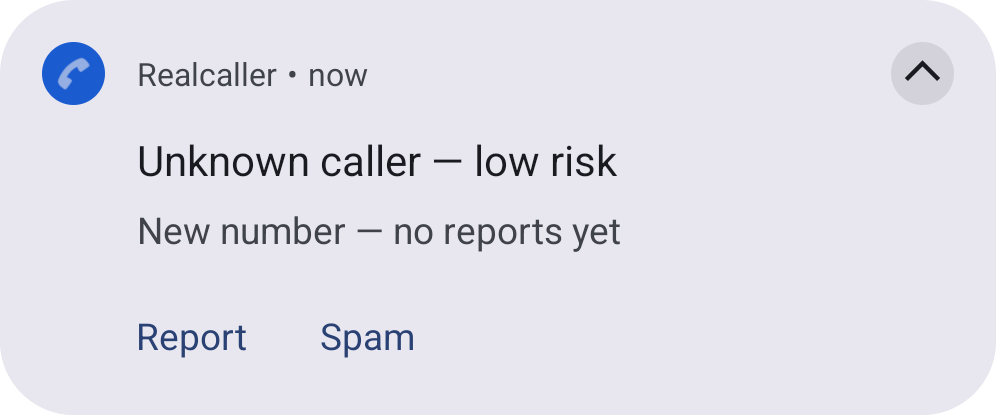
Realcaller card: “Unknown caller, low risk”, new number with no reports yet.
Low risk: a new number with no reports.

Who decides what gets blocked?

You do. Nothing is blocked until you switch it on, and every report needs a second, deliberate step.

Blocking is off until you turn it on

Pick one of three settings in the app:

  • OffDefaultEvery screened call rings, with its card.
  • Block known spamKnown spam never rings. You still get a card, so nothing disappears silently.
  • Block known spam + suspiciousAlso blocks numbers with some spam reports.
A blocked call still gets a card.

Blocked calls still appear in your phone’s call log. Your blocklist and allowed list never leave the phone.

Reports take two deliberate steps

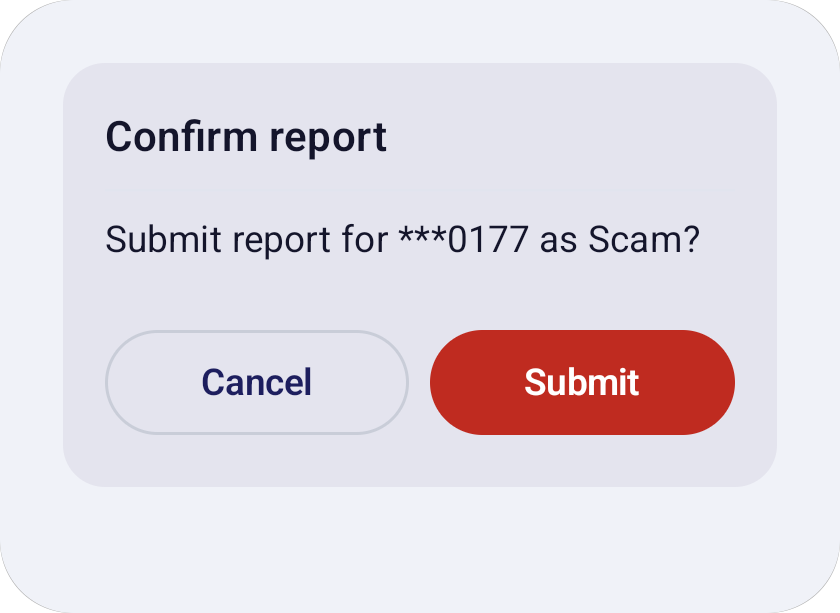
First you pick what kind of call it was, then you confirm. It takes a moment on purpose: careless taps make bad data.
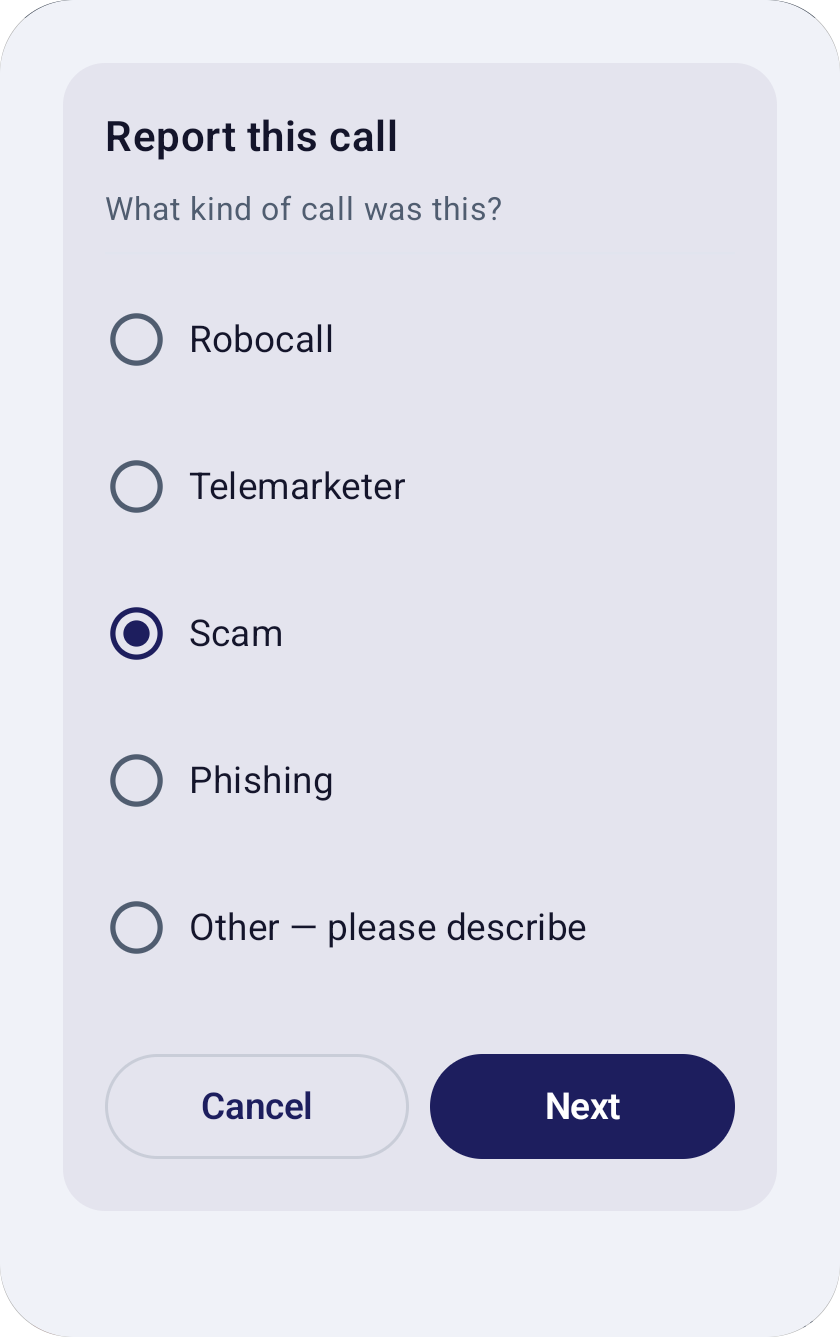
Step 1, Report this call: a list of call types (Robocall, Telemarketer, Scam, Phishing, Other) with Scam selected, and Cancel and Next buttons.
01 Step 1: what kind of call
Step 2, Confirm report: “Submit report for ***0177 as Scam?” with Cancel and Submit buttons.
02 Step 2: confirm
  • One report per number per day from each phone, and up to 10 a day.
  • A report counts on live lookups right away. It reaches other phones’ offline lists once a second phone reports the same number.

What leaves your phone, and what never does?

Most checks happen on the phone. When a lookup is needed, the caller’s number goes to Realcaller’s server over HTTPS, without a device ID. Here is the whole list.
Stays on your phone

Your contacts
Read on the phone if you allow it. Never uploaded, stored or logged.
Your blocklist and allowed list
Matched on the phone. Never sent.
Call history and searches
Up to 500 screened calls and your last 20 searches.
Weekly summary and widget
Counts only, kept on the phone.

Leaves your phone, and when

An unknown caller’s number
Sent for a live lookup when the phone has no answer, with your SIM’s country. No device ID. Numbers the server doesn’t know are kept for 30 days.
A number you search
The same as a live lookup.
A report you send
The number, the category, your note (only for Other) and a random device ID.
A Spam or Not spam tap
The number, the random device ID, the time of the call and the verdict you saw.
The daily list update
Only your region and the time of the last update.

Never accessed

Call log, SMS, location and microphone
The app does not ask for these permissions.
Read every privacy promise

Does it work in Mexico and the United States?

Yes, with different data in each country for now, and Spanish from start to finish.
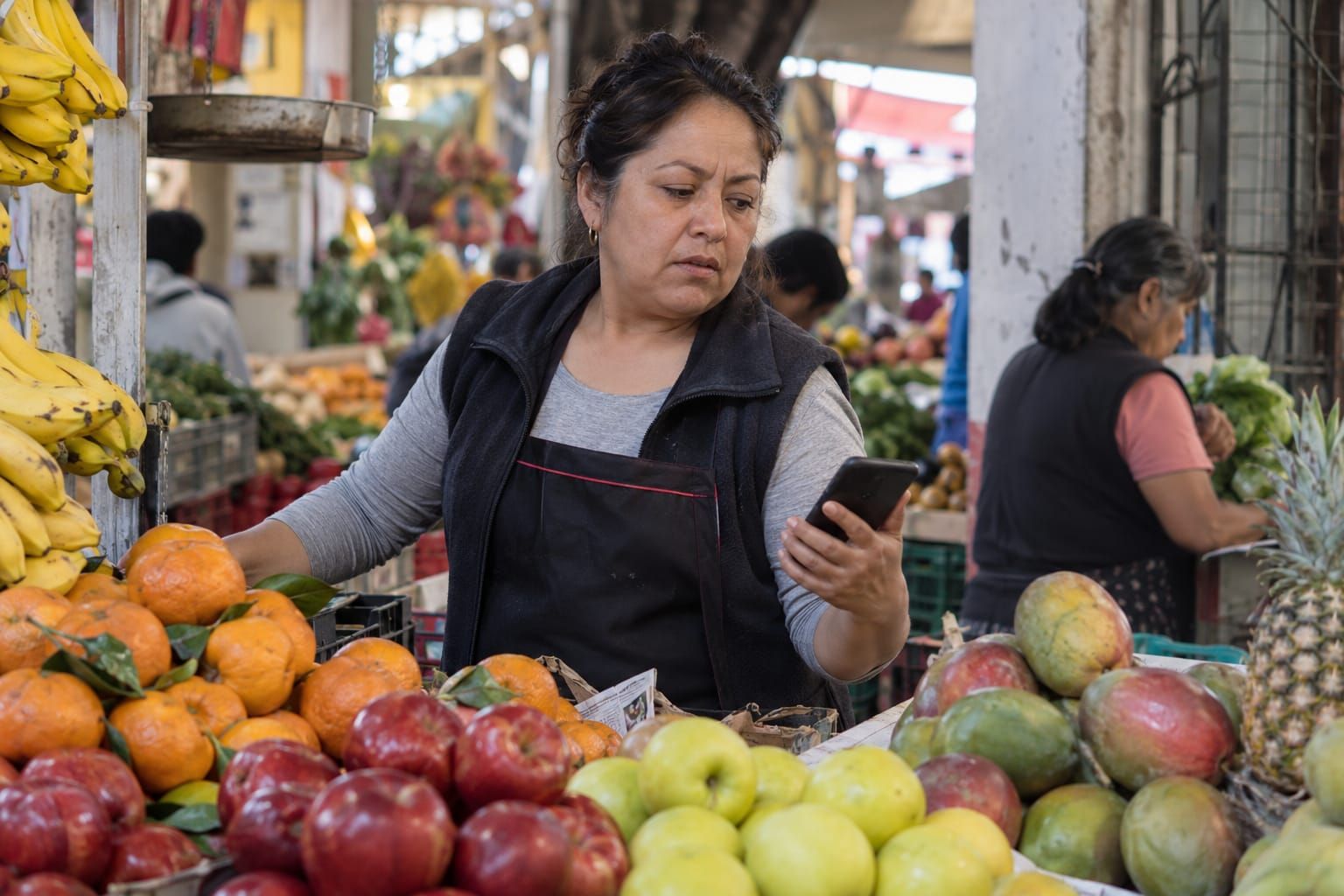
A fruit seller at a Mexico City market looking at her phone.

Mexico

Mexico has no public, downloadable list of reported phone numbers the app can use today: the telecom regulator’s successor publishes none, PROFECO’s data has no numbers, and CONDUSEF offers a manual web lookup but no dataset. So Mexican coverage will come from Realcaller users’ reports. There were none yet as of October 7, 2026.

Until then, a Mexican phone still gets the most-reported US numbers and can look up any number.

Coverage in Mexico

A parent cooking at home while a phone lies on the kitchen counter.

United States

813,371

US numbers from FTC and FCC complaints

FTC + FCCas of

The US list comes from government complaint data, refreshed every week.

Coverage in the United States

The app, the cards and the reasons are all in Spanish written for Mexico and Latin America, using “tú”.

Questions people ask first

All questions

Is Realcaller on Google Play?

Not yet. Realcaller is still in development and there is no public beta. You can join the waitlist at the bottom of this page.

Does Realcaller upload my contacts?

No. If you allow contacts access, the app reads them on your phone so your contacts’ calls pass without a card and their names show in the app. They are never uploaded, stored or logged.

Which phones does it work on?

Android phones only, for now. The app installs on Android 9 and newer. Automatic call screening needs Android 10 or newer and a SIM; number search works without it.

Does it block calls on its own?

Only if you turn it on. Blocking is off by default. You can block known spam, or known spam plus suspicious numbers, and you still get a card for every blocked call.

Join the waitlist

Realcaller is in development and not on Google Play yet. Leave your email and country, and we will use them only for the waitlist.

The form is handled by Formspree. Your email is only used for the waitlist.