Caller ID that posts a card for every screened call
When an unknown number calls, Realcaller checks it and posts a notification card: how risky the number looks, and the reason. Calls from your saved contacts pass without a card.
What does the caller ID in Realcaller do?
It checks an unknown incoming call and tells you what it found before you decide what to do.
Once you choose Realcaller as your phone’s “caller ID & spam app”, each incoming call goes through a fixed set of checks. The result is a notification card with a verdict in words, such as “Known spam call” or “Suspicious caller”, and the first reason behind it, such as “Flagged by FTC”.
The verdict is always carried by the words, not by colour. Cards use the app’s brand blue and a plain phone icon, so a card is never just a red or green light.
What can a card say?
Five things, depending on what is known about the number and whether the check finished in time.
Known spam. The number scores 0.70 or higher. The title carries the caller label when the number has one. Suspicious. The score is from 0.40 up to 0.70: some complaints, not enough to call it known spam. Low risk. Below 0.40, or a number with no reports at all. “Low risk” is not a promise that a call is safe. Not checked. Nothing answered in time: slow network, no connection or a server error. The card says so instead of staying silent. Hidden caller ID. The number cannot be read, so there is nothing to look up. The card asks you to treat the call with caution.
Two more cards belong to blocking: one when a call was blocked, one when you marked a number as allowed. They are on the blocking page.
How does the check work, step by step?
Realcaller works down a fixed list and stops at the first answer. The server is the last stop, not the first.
Your contacts
If you allowed contacts access and the caller is saved, the call passes with no card. Nothing is sent.
Your blocklist and allowed list
Numbers you blocked or marked “Not spam” are handled on the phone. Nothing is sent.
Recent answers in memory
The phone remembers its last answers (about 500, for 15 minutes), so a repeat caller needs no new lookup.
The offline list on your phone
The daily offline list holds up to 10,000 numbers for your region. How the offline list works.
A live lookup
Only if the phone has no answer, it asks the server over HTTPS. If nothing comes back in time, you get the “not checked” card.
What happens when a saved contact calls?
Nothing extra: the call passes silently, with no card.
This only works if you allow the optional contacts permission. The app reads your contacts on the phone to skip them and to show their names in search and call history. Names are looked up when they are shown. They are never stored, logged or uploaded.
Contacts from any app that syncs with Android’s contacts (Google, Samsung, Xiaomi, Huawei or SIM) are recognised the same way.
Where do the cards show up?
Cards are Android notifications, so they follow your phone’s notification settings.
- Spam and blocked calls
- Known spam, suspicious and blocked calls. A pop-up with sound.
- Other screened calls
- Low risk, not checked, hidden and allowed numbers. A pop-up with no sound or vibration.
If notifications are off, screening runs silently and you will see no results, so the app asks for notification access when you set it up. Exactly where the card appears on screen can depend on your phone and its settings.
Can I look up a number myself?
Yes. Type or paste any number in the Calls tab. It shows the phone’s saved answer at once, then always asks the server for the latest.
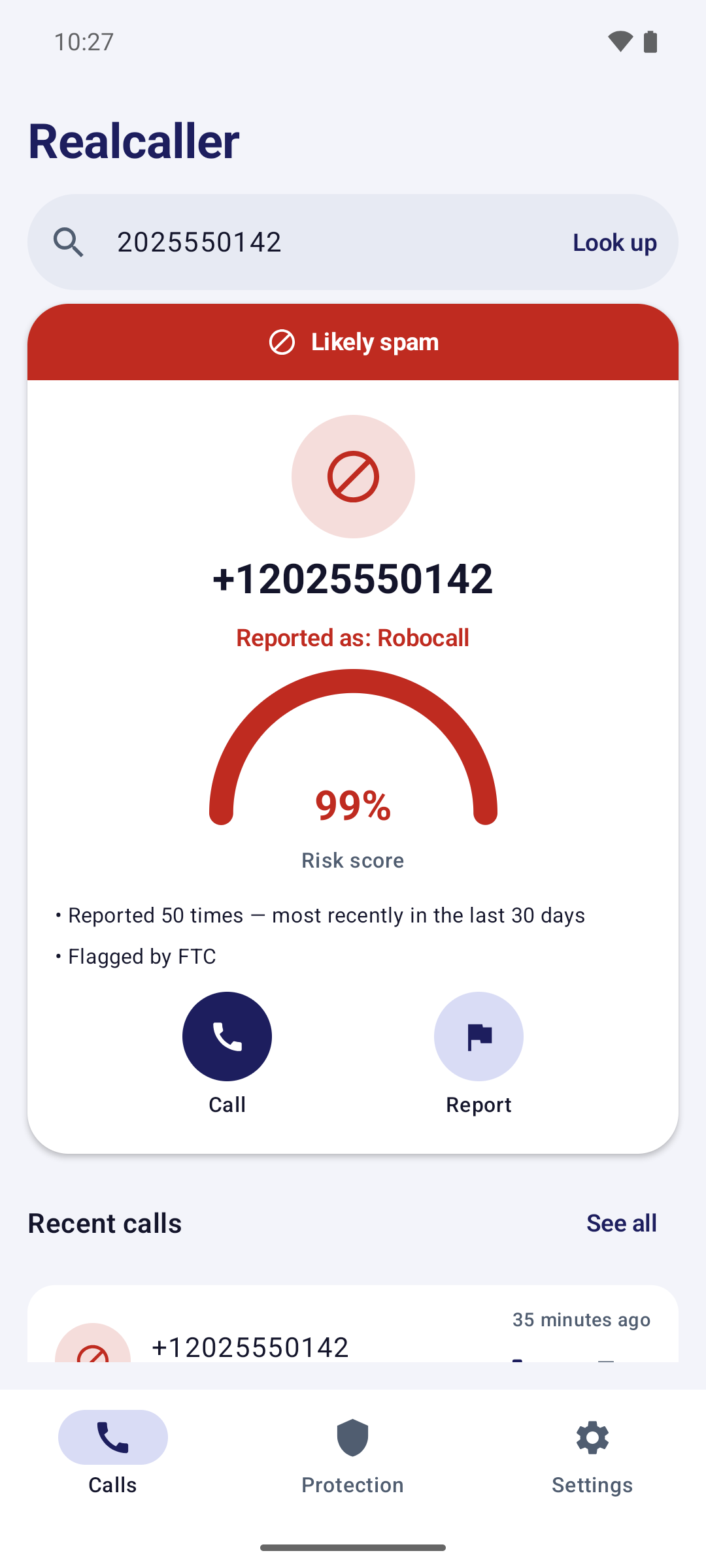
A known spam number: verdict, risk percentage, label and the reasons. 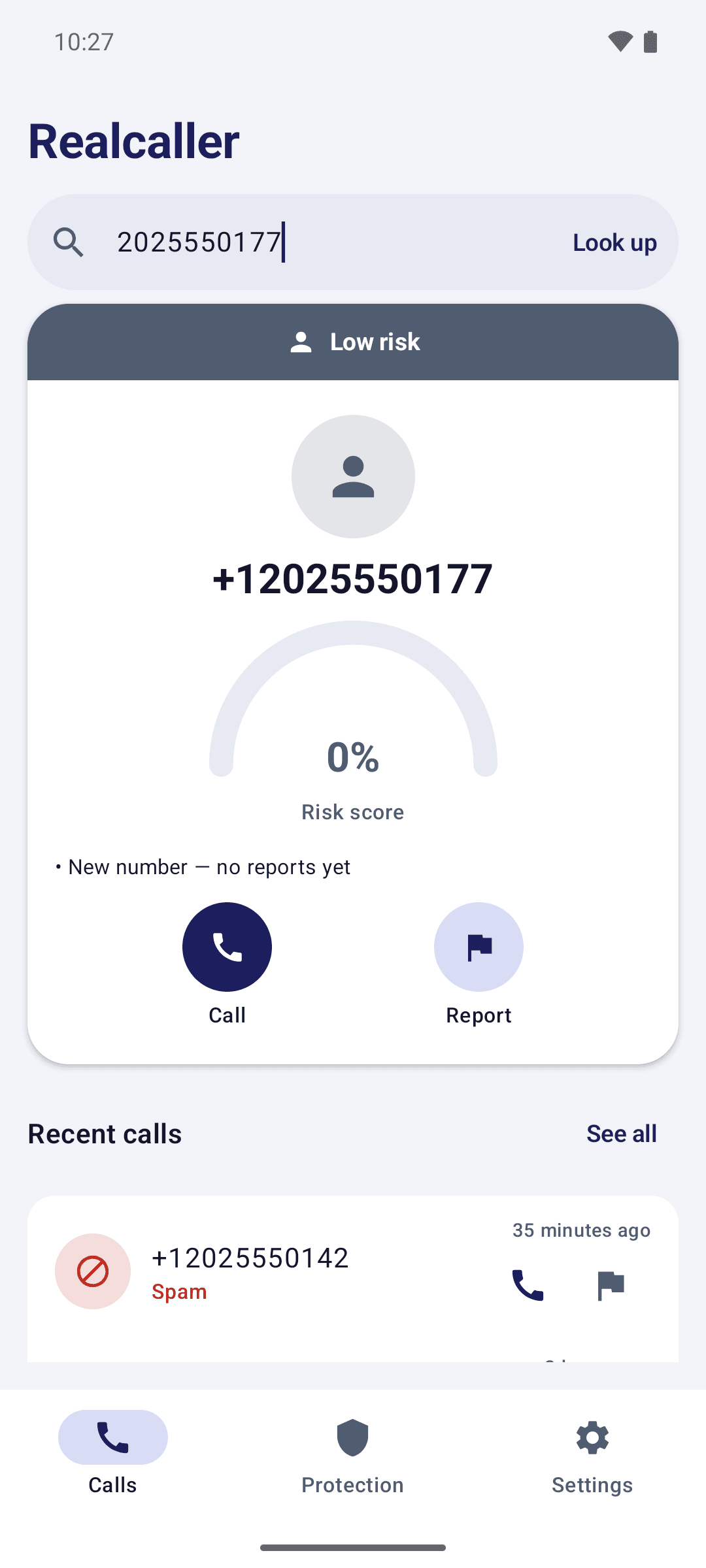
A new number: low risk, and the reason says there are no reports yet. 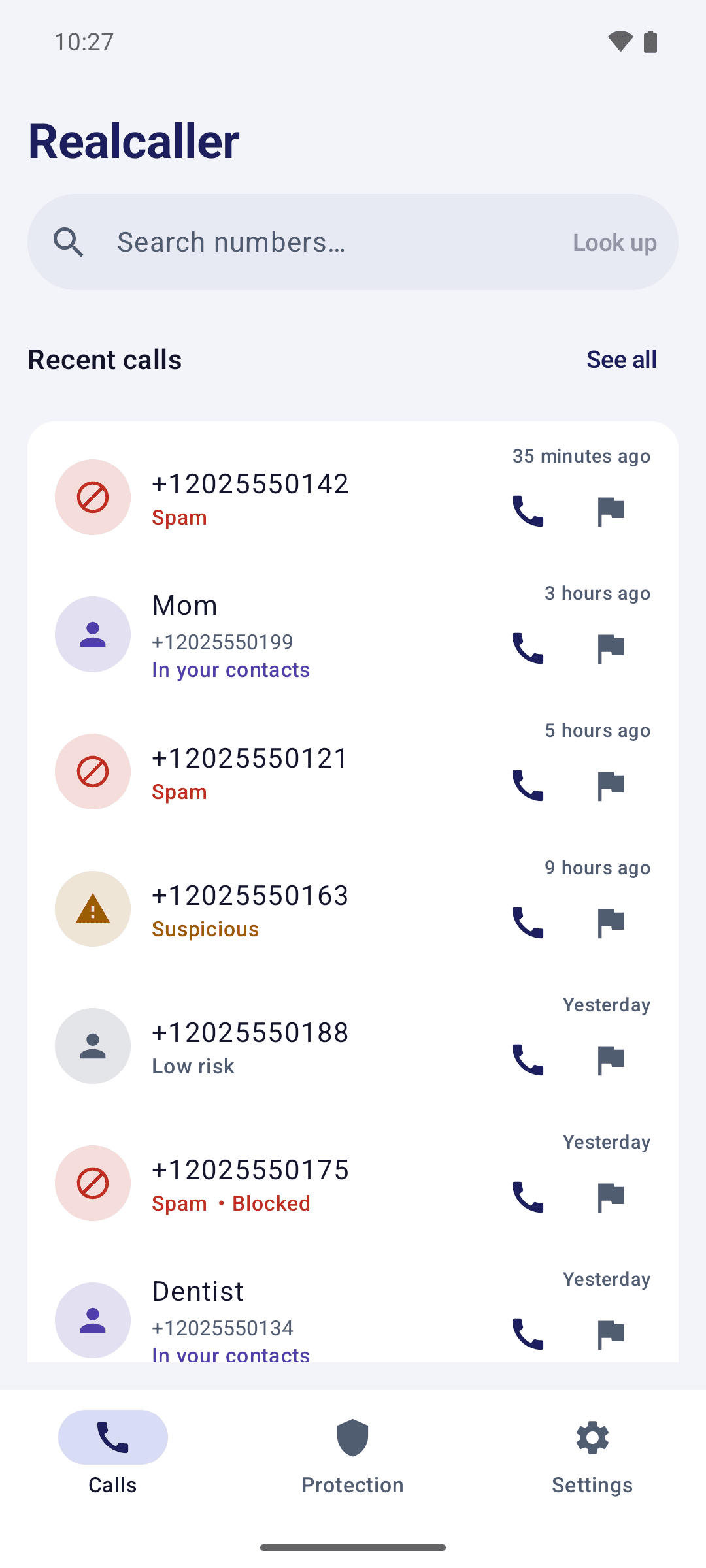
Call history keeps up to 500 screened calls on your phone.
What does caller ID send or keep?
The number of an unknown caller leaves the phone only when the phone has no answer of its own. Nothing else about the call does.
- Sent for a live check
- The caller’s full number and your SIM’s country (or “US” with no SIM), over HTTPS. No device ID.
- Kept by the server
- Only if the number is unknown to the database (or known only from user reports): the number, the country and the time, deleted after 30 days.
- Stays on your phone
- Your contacts, blocklist, allowed list, search history and call history.
- Never accessed
- Your call log, text messages, location and microphone. The app does not ask for those permissions.
The whole picture is on the privacy page.
What are the limits?
Caller ID tells you what the data says. It is not a guarantee about any call.
- Realcaller is not on Google Play yet, and no beta is running. You can join the waitlist below.
- All the spam data today is from the United States (FTC and FCC). There is no Mexican data yet, so a Mexican number with no reports gets “New number, no reports yet”. What the data covers.
- There is no “verified business” card. A number that is not flagged is shown as low risk, not as trusted.
- Android only for now. There is no iPhone app.
- Text messages are not checked. The app screens phone calls.
Caller ID questions
Does every call get a card?
Does it work without internet?
Does it read my contacts?
Does “Low risk” mean the call is safe?
Keep reading

Join the waitlist
Realcaller is in development and not on Google Play yet. Leave your email and country, and we will use them only for the waitlist.